Paul Delvaux's Boob Obsession
Stumbling across Paul Delvaux’s collection of art work was a fascinating journey through warped time and space. His skillful execution of strange worlds that look similar to our own is inspiring. I was impressed by his application of classical style painting to build surreal worlds. But as I continued to explore his library of work I had only one question: What is this dude's obsession with boobs? Nearly all of his paintings featured a nude woman in the foreground, background and mid ground. I’m all for a tasteful nude here and there, but this just seemed obsessive to me.
Giving him the benefit of the doubt, I am going to gloss over the obvious erotic answer and see if there are any deeper reasons to include so many nude women in the overwhelming majority of your work.
Before I start my research I have a few hypotheses as to why Paul Delvaux has obsessively fixated on the female form. The first being that boobs are way easier to paint than clothes due to their smoothness and predictability in form, so maybe Delvaux paints nudes simply because it's quicker and easier than clothing them. Another possibility is he has a consistent message of the vulnerability of women in Belgian society. Displaying lots of nude women could be his own little “free the nipple” movement of the early 1900’s. Or lastly, maybe he is just a lecherous man that shamelessly enjoys sculpting the seductive curvature of a nude woman with his paint brush.
The Origin
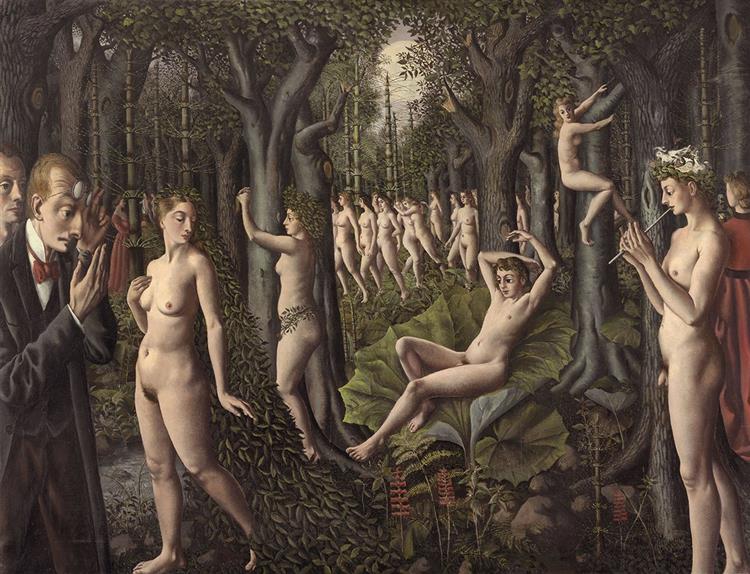
To better understand his motives, I dove into Delvaux’s Biography. During Delvaux’s childhood he read two influential books that inspired him all throughout his life. One being Journey to the Center of the Earth and the other being the Odyssey. It is said that The Awakening of the Forest was directly inspired by a scene in Journey to the Center of the Earth. The painting showcases a forest full of nude women being stumbled upon by an unsuspecting man. This scene of primal nudity and untamed interaction with the forest must have made a deep voyeuristic impression on young Delvaux. Delvaux was also influenced by the Siren scene in the Odyssey and a wax figure of sleeping Venus, which is reflected in his work through repeated themes of sirens and Venus. It seems as though the nudity theme is not something he came up with consciously, but rather a natural gravitation.
One Subject, Many Meanings
Paul Delvaux used the subject of a nude woman over and over again, yet each piece of artwork holds a different message.
Self Expression
Much like the nude women in his paintings, Delvaux refused to fit into expectation and was willing to break the mold. Delvaux was active in the art scene during the genesis of the surrealist movement and was friends with many of the well known pioneers, but he never allowed himself to be lumped in with the crowd. He evaded the box before anyone had the chance to put him in it. Delvaux created freely, like an unclad woman confidently meandering through town. Nude women were a subtle expression for his desire to be free and untethered from societal expectations.
Admiration
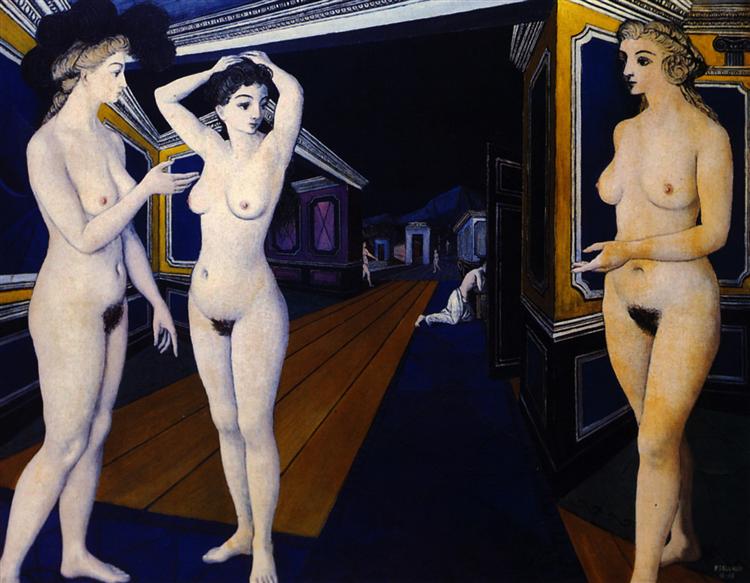
Through my own interpretation of his work I see an admiration of femininity through multiple lenses. In Enigma we see a casual gathering of women in a garden. Each woman garnished with flowers in her hair and a long veil. They are calm and just enjoying each other's company. I see no eroticism in this one, only an appreciation of the sisterhood between women.
On the other hand, some of Delvaux’s paintings do feature an erotic essence. In Phases of the Moon we see a sensually posed woman wrapped in a bow, as if she is offering her presence as a gift. Sometimes this eroticism is encouraged like in Silent Night where two women are seen in a carnal embrace. Other times there are themes of shame, such as in The Temptation of Saint Anthony where in the foreground there are nude women behaving naturally while in the distance we see a man knelt in prayer. Repenting for his sinful gaze, I assume.
Quiet Power
There is also an unspoken power behind the women in Delvaux’s paintings. No matter where they are and how vulnerable they may seem, every single one of them appears confident in their nudity. Hundreds of naked ladies, and not one of them shows a hint of shame or embarrassment. This promotes reverence for the underlying power of a confident woman. In many of his paintings the men dare not look at the nude women. A recurring character of a man removing his glasses to wipe his eye can seen in Phases of the Moon II, The Street at Night, The Awakening of The Forest, and many more of Delvaux’s paintings. I see two interpretations of this man. The first being a man checking his vision after stumbling into an enchanted world heavily sprinkled with bare bodied women, and the second being a reminder to cleanse your lustful eye.
Innocence
Nudity can also be seen as a symbol of innocence. We are all born naked just as we are all born pure. A Visit depicts a young boy entering a woman’s room while they are both naked. To me this scene looks like a moment of childhood and the innocent relationship between a mother and her son. Another interpretation of innocence coincides with guilt. Ball is a mysterious scene. A clothed woman ponders over a nude woman’s lifeless body. My imagination tells me this clothed woman had something to do with the downfall of the nude woman on the floor. Ball uses clothing and nudity as a symbol of innocence and corruption, much like the biblical story of Adam and Eve.
Surreal Emphasis
The use of a nude woman can also exaggerate the surrealistic feel of a space. It is not common for women to be nude out in public, but it is in Delvaux’s paintings. Just like it is not common to see places and landscapes holding the obscure construction seen in his work. In Night Garden the landscape is like no place on Earth. An eerie moon shines on desolate trees in front of a complex city backed by mountains, with oddly posed nude women dispersed throughout the desert-like landscape. We can imagine how the man on the left felt walking into such a scene. Delvaux’s use of nude women adds to the unfamiliarity of a scene composed of familiar subjects.
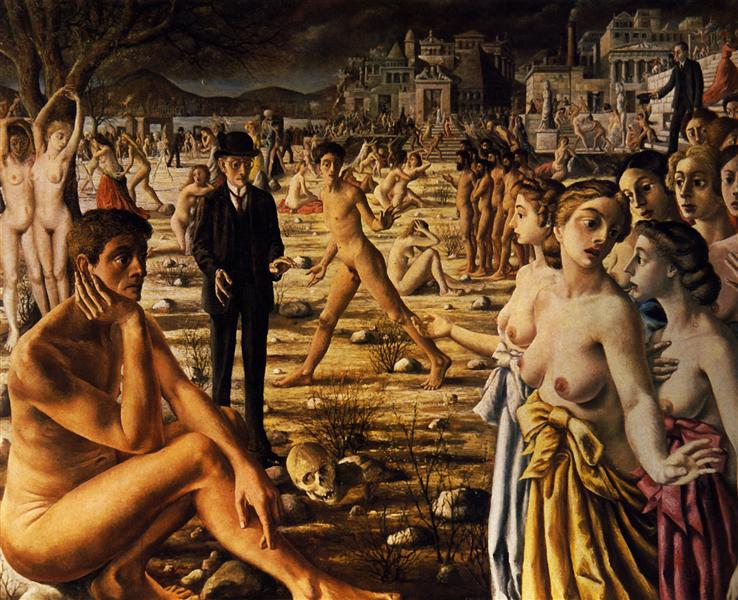
He does something similar in City Worried but instead of highlighting the mystery like before, the nudity highlights the instinctive chaos of the moment captured. City Worried was an artistic interpretation of the day Nazi Germany invaded Belgium, Delvaux’s home country. In this painting we see infinite clusters of nudity, all reacting to tragedy in different ways. Some carry relaxed expressions, some show their worry, some are fighting and some are running. The nudity underscores the vulnerability those people must have felt in that moment. And to contrast everything else we see two clothed men, one seemingly stunned yet still doing his best to uphold calm conformity. And the other off in the distance appears as though this is just another Tuesday. The juxtaposition between the nude figures and clothed figures emphasized the contrast between human impulses and social etiquette.
Final Thoughts
I may never actually know the reason Paul Delvaux continuously painted naked women, but it sure was fun to speculate. A great artist always leaves room for interpretation and Delvaux has proven to be nothing less than excellent. I admire his ability to use the same subjects over and over again to send out different messages and evoke a variety of emotions. His imagination for creation has reminded me that newness can be born out of something as ancient as nudity. He did not reinvent the wheel, but rather used the wheel to take the onlooker to new lands only tangible through his art.